
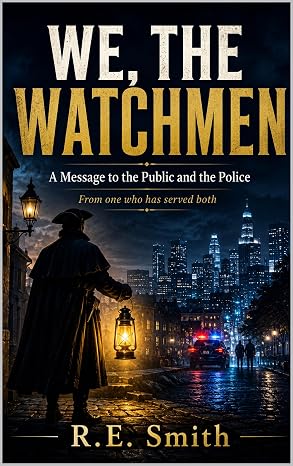
We, The Watchmen
A Message to the Public and the Police From one who has served both
We, The Watchmen
Before police were a profession, keeping the peace belonged to the people.
Long before patrol cars, badges, radios, and blue uniforms, ordinary citizens stood watch over their own streets. They answered the hue and cry, guarded the gates, and accepted a duty to protect their neighbors because there was no professional force waiting around the corner. The responsibility for maintaining order was woven into the fabric of community life, grounded in the understanding that peace could not be left entirely to someone else.
We, The Watchmen traces the evolution of that responsibility through centuries of English and American history, beginning with ancient English peace-pledges and community watchmen, moving through the Bow Street Runners and Robert Peel's New Police, and continuing into the professional reforms of August Vollmer. It examines the development of community policing, the influence of broken-windows theory, and the fractured public debate surrounding law enforcement in the aftermath of George Floyd's death. Across these changing eras, one enduring question emerges: when did keeping the peace become something we expected the police to do alone?
Written by an author who has served both the public and the police, this book is neither an attack on law enforcement nor an unquestioning defense of it. Instead, it examines the historical foundations of policing, the changing relationship between officers and the communities they serve, and the responsibilities that belong to both. Its central argument is straightforward: police officers are drawn from the public, and the public cannot surrender its responsibility for the peace and safety of its own neighborhoods simply because policing has become a profession.
At a time when public trust is strained, political disagreements run deep, and the relationship between citizens and law enforcement is increasingly fractured, We, The Watchmen offers a historical and deeply personal perspective on what has been lost and what might still be restored. It asks readers on both sides of the badge to look beyond the arguments of the moment and reconsider an older principle: a peaceful community is not built by authority alone, but through shared responsibility, mutual accountability, and a willingness to stand for one another.
The badge may carry authority.
But the people carry the power.