
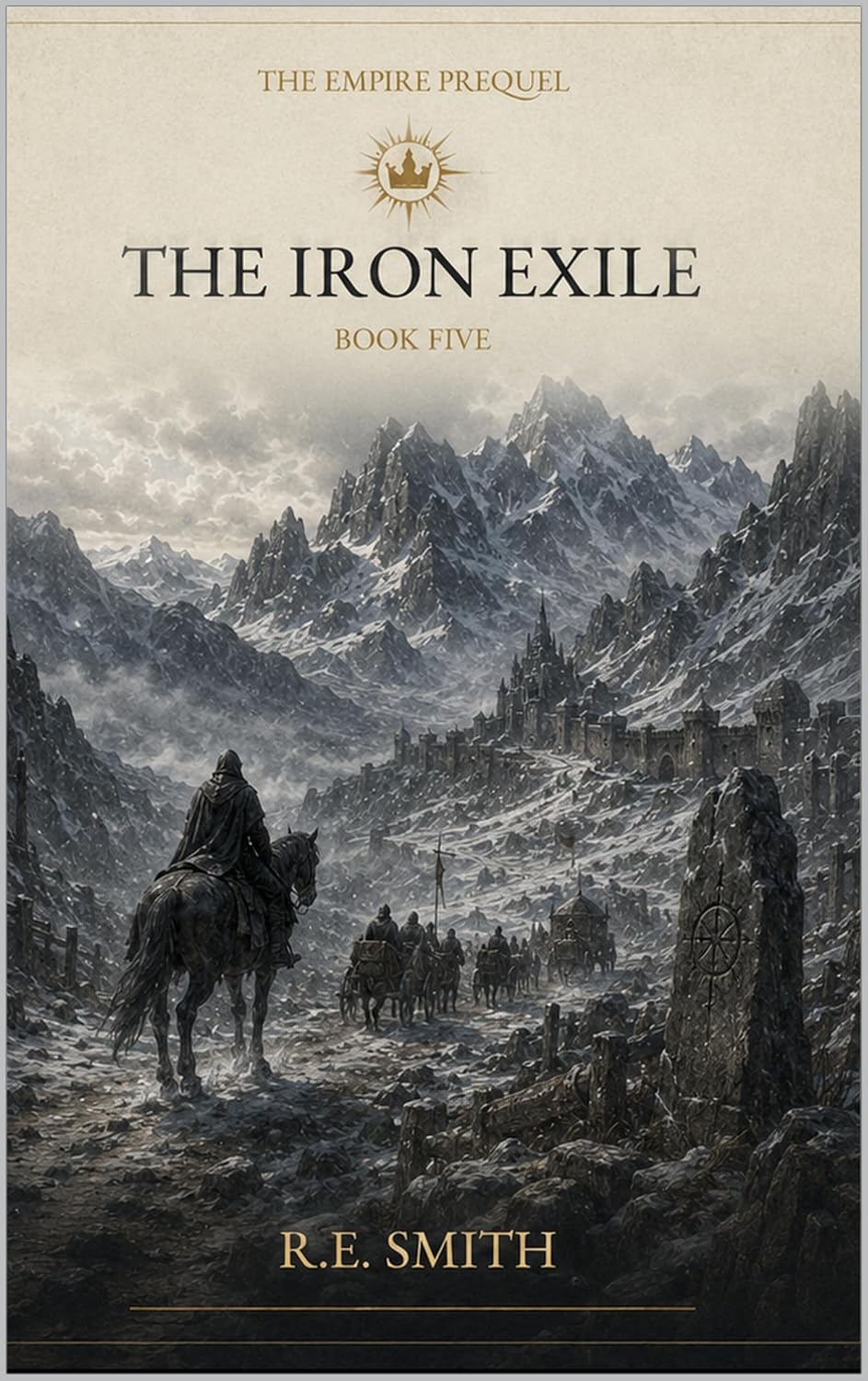
The Empire Prequel · BOOK 5.0
Coming Soon
The Empire Prequel
The Iron Exile
The Iron Exile
Book Five of The Empire Prequel
The accusation was never proved. The exile survived it anyway.
A missing bronze key should have been little more than an inventory problem. Instead, contradictory records begin pointing north. One old transfer sheet mentions Temür bronze, while another makes no reference to it at all. A copied note suggests that a missing register key may have traveled with repair material decades earlier, but no one can establish whether the account is accurate. There is no proof, no reliable witness, and no clear chain of custody. There is, however, enough uncertainty to justify an investigation.
The investigation becomes an audit. The audit becomes suspicion, and suspicion begins moving families.
At first, the language remains carefully chosen. No one is being expelled, only relocated for review. Nothing is being confiscated, merely examined. No one has been declared guilty, but certain bronze materials are now restricted. Each phrase is defensible on its own. Together, they form a machinery of displacement that becomes increasingly difficult to stop.
As workshops close and households are ordered to move, Iron Hearth fills with smiths, children, widows, tools, wagons, records, and people who never intended to become part of anything larger than the struggle to survive. From a distant administrative office, the growing settlement looks increasingly suspicious. It resembles a concentration of skilled labor, then a technical center, and eventually, in the eyes of officials, something dangerously close to a fortress. On the ground, however, it is still a collection of workshops, cooking fires, crowded latrines, family debts, quarrelsome cousins, and one particularly troublesome goat standing on a wall someone has labeled defensive works.
Orun Temür understands the danger of records better than most. His family has spent generations preserving them, trusting that accurate accounts and carefully maintained histories would protect what mattered. Now the state is using that very continuity against him. When an official offers to remove Ayla, Arslan, Saran, and their household from relocation review in exchange for a single bronze calibration key, the proposal contains no explicit threat. It does not need one. The offer is presented as a reasonable administrative accommodation, which somehow makes it worse.
Meanwhile, relocation itself has become an industry. Wagons must be contracted, belongings stored, transport certified, inspectors approved, and replacement craftsmen found. The machinery of displacement develops its own economy, complete with fees, procedures, and people who discover that there is money to be made whenever someone else is forced to move. Nothing requires outright corruption. Once displacement has a price, someone can always build a business around moving people.
Then Iron Hearth burns.
Families scatter, and the archives officials expected to seize turn out never to have existed in one convenient place. Household records travel beneath blankets beside sacks of onions. Children carry spoons, bent nails, and whatever remaining pieces of home can fit inside a wagon. The official investigation begins to weaken, but by then the damage has spread far beyond the original accusation. Homes have been abandoned, livelihoods destroyed, families separated, and an entire community forced to reconsider where it belongs.
The accusation was never proved. The dispersal remains.
Now the state must confront a far more difficult question: what does justice look like when returning home finally becomes possible?
Some want their homes restored. Others want compensation, while some want nothing more than the graves of their families returned to their care. There are those who want their workshops back but have no desire to live where they once did. And there are people who, given the opportunity to return, choose not to.
Because the right to go home means very little if someone else still gets to decide where home is supposed to be.
The Iron Exile is Book Five of The Empire Prequel, continuing the six-book saga of how investigation becomes policy, policy becomes displacement, and institutions can preserve injustice long after the original accusation has collapsed.
For readers who enjoy political epic fantasy, sweeping family sagas, ancient technology, contested evidence, legal intrigue, forced relocation, institutional power, dry humor, and morally complex stories about the people caught between history and the machinery of government.
They searched for one missing key. They found an entire people easier to move.